
How We Make Performance a Guarantee.
Determinism isn’t a feature you add — it’s an architecture you commit to. flexgrid.cloud is engineered top to bottom for one outcome: real-time AI that performs the same every time, everywhere it runs.
From a passively cooled rack to a kernel-space scheduler to a globally routed fabric, every layer is built to remove the variance that best-effort clouds tolerate. This is the stack behind the SLOT.
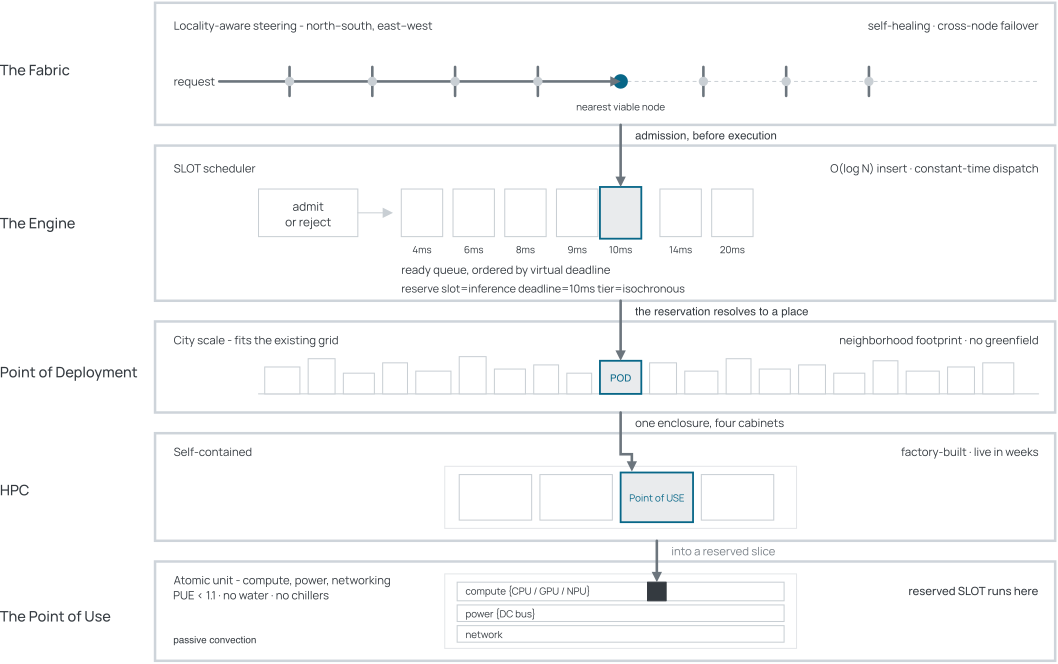
The Stack
Five Layers, One Deterministic Fabric.
Vertical integration is the moat. Because we own every layer, guaranteeing propagation from silicon to the global fabric, not the other way around.
Layers 1 & 2 & 3 — Physical
POD, Cabinet and Compute Node.
A POD (Point of Deployment) is a self-contained, prefabricated enclosure. Inside it, the cabinet is the atomic unit of capacity, pre-integrated compute, power, and networking, factory-built and revenue-ready in weeks. Deployment is constrained only by site and location, not by construction.
Passive by Design

Patent-pending passive thermal management replaces HVAC entirely.

  • PUE < 1.1
  • No water draw, no chillers
  • Same density, lower cost
DC Power Bus

Direct-current distribution cuts conversion loss and extends equipment life.

  • Dynamic voltage & frequency scaling
  • Renewable-ready integration
City Scale

Fits existing grid and edge infrastructure; no greenfield build.

  • Neighborhood footprint
  • Modular, repeatable units
  • Constrained only by site
Layers 4 — The Engine
Inside the SLOT Scheduler.
SLOT is where best-effort becomes guaranteed. It runs in kernel space in Linux, mapping each workload’s DAG to virtual-deadline tasks. A reservation is admitted before execution, so the slice of compute is yours the moment your turn arrives. No sharing, no queuing, no noisy neighbors.
Admission
Constant-time slot dispatch on the hot path, scheduling overhead stays flat as the fabric grows.
O(log N)
Ready DAG nodes are ordered in a red-black tree by virtual deadline for deterministic pick-next.
Isochronous
Enforce SLOT windows and honor hard latency bounds.
Two Principles, Enforced In The Kernal
Spatial Intelligence. Temporal Precision.
The Engine pins each request to the nearest viable node, prioritizing real-time over batch. Together they convert SLOs, QoS, and SLAs from aspirations into terms the scheduler physically enforces.
Policy
reserve slot=inference-rt deadline=10ms tier=isochronous
Admit
O(1) dispatch → node pinned by spatial locality
Enqueue
DAG → queue with virtual_deadline // O(log N) pick-next
Guarantee
p99 latency ≤ SLO · throughput floor held · no contention
Layers 5 — The Fabric
The Distributed Fabric Layer.
Individual PODs become one logical compute plane through an ultra-low-latency mesh that sits between hyperscale clouds and your users. Requests resolve to the nearest optimal node, POD, cabinet, and node selected for the fastest path, and always secured end to end.
Locality-Aware Steering
Geographic and latency-based request routing via the SLOT scheduler — north–south and east–west.
Self-Healing Mesh
Automatic fault detection, cross-node failover, and multi-region redundancy with burst capacity.
No Rewrites
Deploy workloads from public cloud to the flexgrid.cloud gateway without re-architecture.